Erode Venkatappa Ramasamy
Thanthai Periyar
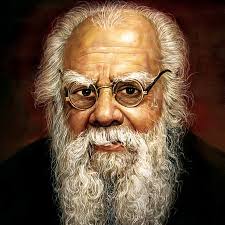
Erode Venkatappa Ramasamy (17 September 1879 – 24 December 1973), was commonly known as Periyar also referred to as E. V. R. or Thanthai Periyar, was a social activist, and politician who started the Self-Respect Movement and Dravidar Kazhagam.
E.V. Ramasamy was born in Erode, Madras Presidency to a wealthy family of Balijas. At a young age, he witnessed numerous incidents of caste and gender discrimination.
E.V. Ramasamy joined the Indian National Congress in 1919, but resigned in 1925 when he felt that the party was only serving the interests of the Brahmins. He questioned the subjugation of Dravidians as the Brahmins enjoyed gifts and donations from them but opposed and discriminated them in cultural and religious matters.In 1924, E.V. Ramasamy participated in a non-violent agitation (satyagraha) in Vaikam, Kerala. From 1929 to 1932 Ramasamy toured British Malaya, Europe, and Russia, which had an influence on him.In 1939, E.V. Ramasamy became the head of the Justice Party,and in 1944, he changed its name to Dravidar Kazhagam. The party later split and one group led by C. N. Annadurai formed the Dravida Munnetra Kazhagam (DMK) in 1949. While continuing the Self-Respect Movement, he advocated for an independent Dravida Nadu
E.V. Ramasamy propagated the principles of rationalism, self-respect, women’s rights and eradication of caste. He opposed the exploitation and marginalisation of the non-Brahmin Dravidian people of South India and the imposition of what he considered Indo-Aryan India.
Early year
E.V. Ramasamy's father, a rich Kannada Baliga businessman, was Venkatappa Naicker, and his mother was Chinna Thayammal, alias Muthammal. He had one elder brother named Krishnaswamy and two sisters named Kannamma and Ponnuthoy. He later came to be known as "Periyar" meaning 'respected one' or 'elder' in Tamil.
E.V. Ramasamy married when he was 19, and had a daughter who lived for only 5 months. His first wife, Nagammai, died in 1933.E.V. Ramasamy married for a second time in July 1948. His second wife, Maniammai, continued E.V. Ramasamy's social work after his death in 1973, but his thoughts and ideas then were advocated by Dravidar Kazhagam.
In 1929, E.V. Ramasamy announced the deletion of his caste title Naicker from his name at the First Provincial Self-Respect Conference of Chengalpattu. He could speak three Dravidian languages: Kannada,Telugu and Tamil. Periyar attended school for five years after which he joined his father's trade at the age of 12. He used to listen to Tamil Vaishnavitegurus who gave discourses in his house enjoying his father's hospitality. At a young age, he began questioning the apparent contradictions in the Hindu mythological stories. As Periyar grew, he felt that people used religion only as a mask to deceive innocent people and therefore took it as one of his duties in life to warn people against superstitions and priests.
Congress Party Member (1919–1925)
E.V. Ramasamy joined the Indian National Congress in 1919 after quitting his business and resigning from public posts. He held the chairmanship of Erode Municipality and wholeheartedly undertook constructive programs spreading the use of Khadi, picketing toddy shops, boycotting shops selling foreign cloth, and eradicating untouchability. In 1921, Periyar courted imprisonment for picketing toddy shops in Erode. When his wife as well as his sister joined the agitation, it gained momentum, and the administration was forced to come to a compromise. He was again arrested during the Non-Cooperation movement and the Temperance movement.
In 1922, Periyar was elected the President of the Madras Presidency Congress Committee during the Tirupur session, where he advocated strongly for reservation in government jobs and education. His attempts were defeated in the Congress party due to a strong presence of discrimination and indifference, which led to his leaving the party in 1925.
Vaikom Satyagraha (1924–1925)
In Vaikom, a small town in Kerala state, then Travancore, there were strict laws of untouchability in and around the temple area. Dalits, also known as Harijans were not allowed into the close streets around and leading to the temple, let alone inside it. Anti-caste feelings were growing and in 1924 Vaikom was chosen as a suitable place for an organised Satyagraha. Under his guidance a movement had already begun with the aim of giving all castes the right to enter the temples. Thus, agitations and demonstrations took place. On the fourteenth of April, Periyar and his wife Nagamma arrived in Vaikom. They were immediately arrested and imprisoned for participation. In spite of Gandhi's objection to non-Keralites and non-Hindus taking part, Periyar and his followers continued to give support to the movement until it was withdrawn. He received the title Vaikom Veeran, given by his followers who participated in the Satyagraha.
The way in which the Vaikom Satyagraha events have been recorded provides a clue to the image of the respective organisers. In an article entitled Gandhi and Ambedkar, A Study in Leadership, Eleanor Zelliot relates the 'Vaikom Satyagraha', including Gandhi's negotiations with the temple authorities in relation to the event. Furthermore, the editor of E.V. Ramasamy's Thoughts states that Brahmins purposely suppressed news about E.V. Ramasamy's participation. A leading Congress magazine, Young India, in its extensive reports on Vaikom never mentions E.V. Ramasamy.
Self-Respect Movement :
Periyar and his followers campaigned constantly to influence and pressure the government to take measures to remove social inequality,even while other nationalist forerunners focused on the struggle for political independence. In 1952, the Periyar Self-Respect Movement Institution was registered with a list of objectives of the institution from which may be quoted as for the diffusion of useful knowledge of political education; to allow people to live a life of freedom from slavery to anything against reason and self respect; to do away with needless customs, meaningless ceremonies, and blind superstitious beliefs in society; to put an end to the present social system in which caste, religion, community and traditional occupations based on the accident of birth, have chained the mass of the people and created "superior" and "inferior" classes... and to give people equal rights; to completely eradicate untouchability and to establish a united society based on brother/sisterhood; to give equal rights to women; to prevent child marriages and marriages based on law favourable to one sect, to conduct and encourage love marriages, widow marriages, inter caste and inter-religious marriages and to have the marriages registered under the Civil Law; and to establish and maintain homes for orphans and widows and to run educational institutions.
Propagation of the philosophy of self respect became the full-time activity of Periyar since 1925. A Tamil weekly Kudi Arasu started in 1925, while the English journal Revolt started in 1928 carried on the propaganda among the English educated people.The Self-Respect Movement began to grow fast and received the sympathy of the heads of the Justice Party from the beginning. In May 1929, a conference of Self-Respect Volunteers was held at Pattukkotai under the presidency of S. Guruswami. K.V. Alagiriswami took charge as the head of the volunteer band. Conferences followed in succession throughout the Tamil districts of the former Madras Presidency. A training school in Self-Respect was opened at Erode, the home town of Periyar. The object was not just to introduce social reform but to bring about a social revolution to foster a new spirit and build a new society.
As President of the Justice Party (1938–1944) :
A political party known as the South Indian Libertarian Federation was founded in 1916, principally to oppose the economic and political power of the Brahmin groups. The party's goal was to render social justice to the non-Brahmin groups. To gain the support of the masses, non-Brahmin politicians began propagating an ideology of equality among non-Brahmin castes. Brahmanical priesthood and Sanskritic social class-value hierarchy were blamed for the existence of inequalities among non-Brahmin caste groups.
In 1937, when the government required that Hindi be taught in the school system, E.V. Ramasamy organised opposition to this policy through the Justice Party. After 1937, the Dravidian movement derived considerable support from the student community. In later years, opposition to Hindi played a big role in the politics of Tamil Nadu. The fear of the Hindi language had its origin in the conflict between Brahmins and non-Brahmins. To the Tamils, acceptance of Hindi in the school system was a form of bondage. When the Justice Partyweakened in the absence of mass support, E.V. Ramasamy took over the leadership of the party after being jailed for opposing Hindi in 1939.Under his tutelage the party prospered, but the party's conservative members, most of whom were rich and educated, withdrew from active participation.
Dravidar Kazhagam (1944–onwards) :
Formation of the Dravidar Kazhagam
At a rally in 1944, Periyar, in his capacity as the leader of the Justice Party, declared that the party would henceforth be known as the Dravidar Kazhagam, or "Dravidian Association". However, a few who disagreed with Periyar started a splinter group, claiming to be the original Justice Party. This party was led by veteran Justice Party leader P. T. Rajan and survived until 1957.
The Dravidar Kazhagam came to be well known among the urban communities and students. Villages were influenced by its message. Hindi, and ceremonies that had become associated with Brahmanical priesthood, were identified as alien symbols that should be eliminated from Tamil culture. Brahmins, who were regarded as the guardians of such symbols, came under verbal attack.From 1949 onwards, the Dravidar Kazhagam intensified social reformist work and put forward the fact that superstitions were the cause for the degeneration of Dravidians. The Dravidar Kazhagam vehemently fought for the abolition of untouchability amongst the Dalits. It also focused its attention on the liberation of women, women's education, willing marriage, widow marriage, orphanages and mercy homes.
Split with Annadurai
In 1949, E.V. Ramasamy's chief lieutenant, Conjeevaram Natarajan Annadurai, established a separate association called the Dravida Munnetra Kazhagam (DMK), or Dravidian Progressive Federation. This was due to differences between the two, while Periyar advocated a separate independent Dravidian or Tamil state, Annadurai compromised with the Delhi government, at the same time claiming increased state independence.E.V. Ramasamy was convinced that individuals and movements that undertake the task of eradicating the social evils in the Indian sub-continent have to pursue the goal with devotion and dedication without deviating from the path and with uncompromising zeal. Thus, if they contest elections aiming to assume political power, they would lose vigour and sense of purpose. But among his followers, there were those who had a different view, wanting to enter into politics and have a share in running the government. They were looking for an opportunity to part with E.V. Ramasamy.Thus, when E.V. Ramasamy married Maniammai on 9 July 1948, they quit the Dravidar Kazhagam, stating that E.V. Ramasamy married maniammayar who was daughter of kanagasabhai when he was 70 and she 32. Those who parted company with E.V. Ramasamy joined the DMK. Though the DMK split from the Dravidar Kazhagam, the organisation made efforts to carry on E.V. Ramasamy's Self-Respect Movement to villagers and urban students. The DMK advocated the thesis that the Tamil language was much richer than Sanskrit and Hindi in content, and thus was a key which opened the door to subjects to be learned.The Dravidar Kazhagam continued to counter Brahminism, Indo-Aryan propaganda, and uphold the Dravidians' right of self-determination.
Later years
In 1956, despite warnings from P. Kakkan, the President of the Tamil Nadu Congress Committee, Periyar organised a procession to the Marina to burn pictures of the Hindu God Rama. Periyar was subsequently arrested and confined to prison.
The activities of Periyar continued when he went to Bangalore in 1958 to participate in the All India Official Language Conference. There he stressed the need to retain English as the Union Official Language instead of Hindi. Five years later, Periyar travelled to North India to advocate the eradication of the caste system. Nearing Periyar's last years, an award was given to him by the United Nations Educational Scientific and Cultural Organization (UNESCO), and it was presented to him by the Union Education Minister, Triguna Sen in Madras (Chennai), on 27 June 1970. In his last meeting at Thiagaraya Nagar, Chennai on 19 December 1973, Periyar declared a call for action to gain social equality and a dignified way of life. On 24 December 1973, Periyar died at the age of 94.
Periyar University
The Government of Tamil Nadu established Periyar University at Salem on 17 September 1997, as per the provisions of the Periyar University Act, 1997. The university caters to affiliated colleges under the area comprising the districts of Salem, Namakkal, Dharmapuri and Krishnagiri. The university got 12(B) and 2f status from the University Grants Commission and was accredited by NAAC with B+ grade in 2007, which was upgraded to 'A' during the reaccreditation in May 2015.
Periyar E.V. Ramasamy quotes
- “Foreigners are sending messages to the planets. We are sending rice and cereals to our dead fore-father through the Brahmins. It is a wise deed?”
- “If god is the root cause for our degradation destroy that god. If it is religion destroy it. If it is Manu Darma, Gita, or any other Mythology (Purana), burn them to ashes. If it is temple, tank, or festival, boycott them. Finally if it is our politics, come forward to declare it openly.”
- “Decide for yourselves as to what you should thing of those who say there is God, that he is the preserver of justice and that he is the protector of all, even after seeing the practice of untouchablity in the form of man being banned from human sight and contact, from walking into the streets, from entering the temples and drawing water from a tank, is rampant in the land, and yet that land is not spared from being razed by an earthquake, burnt by the fiery lava of a volcano, engulfed in a deluge from the ocean, submerged in the chasm of the earth, or fragemented by thunder-storm.”
- “Only education, self-respect and rational qualities will uplift the down-trodden.”
- “Man treats woman as his own property and not as being capable of feelings, like himself.”
- “Man treats woman as his own property and not as being capable of feelings, like himself. The way man treats women is much worse than the way landlords treat servants and the high-caste treat the low-caste. These treat them so demeaningly only in situations mutually affecting them; but men treat cruelly and as slaves, from their birth till death.”
- “I want to say a word to the Brahmins: In the name of God, religion, sastras you have duped us. We were the ruling people. Stop this life of cheating us from this year. Give room for rationalism and humanism.”
- “Till the end of my life, I shall never canvas for a vote. I shall not even expect a word of praise from any quarter.”
- “To discard what is unwanted, and to retain what is needed, is what reform means.”
- “The terms `Husband' and `Wife' are inappropriate. They are only companions ad partners. One does not slave for other. They both have equal status.”
- “When the purpose of clearly exposing the differences between the Aryan and the Tamil culture, civilization, conduct and creed Thirukkural was written. I am of that firm view.”
- “Wisdom lies in thinking. The spear-head of thinking is rationalism.”
- “You cannot expect any rational thought from a religious man. He is like a rocking log in water.”
- “People are talking high of Thiruvalluvar. But in practice they do not respect his teachings. They act against him and disregard him.”
- “Whomsoever I love and hate, my principle is the same. That is, the educated, the rich and the administrators should not suck the blood of the poor.”
- “Even those, who some time ago believed all the stories about God, that is who believed that divine power exists, have now come to be so ashamed of their own belief, hiding their ignorance, they are now struggling hard to prove those stories as scientifically true.”
- “Many crores of rupees are squandered in this country by way offering gratitude to God and bribing Him to gain greater and greater wealth.”
- “Women in India experience much worse suffering, humiliation and slavery in all spheres than even the untouchables.”
- “The duty and the responsibility of a rationalist is to thoughtfully and promptly carry out his actions, in fraternal affection, without considering country, language, God, religion and caste.”
- “Every one has the right to refute any opinion. But no one has the right to prevent its expression.”
- “By helping the poor, we must be able to remove their poverty. By extending help to one here and one there in the form of providing food will not remove poverty.”
- “I want the Brahmins to realize that the Dravidian people today are very much hating those who cunningly cheated them with absurdities. They are now aware of the particular community making a living by spreading the foolishness. People have begun to hate god, religion, caste, mythologies (puranas) and so on.”
- “We do not need to explain how the Aryans entered and settled in the Dravidian country, and subjugated and oppressed the Dravidians. Nor do we need to explain how before the Aryans entered the Dravidian country, the Dravidian country had a civilization and arts of the highest rank.”
- “We do not need to explain how the Aryans entered and settled in the Dravidian country (tira¯vit»a na¯» t»u), and subjugated and oppressed the Dravidians. Nor do we need to explain how before the Aryans entered the Dravidian country, the Dravidian country had a civilization and arts of the highest rank.”
- “We see morality in speeches and writings. We do not find it in practice. We are having different regulations for the males and the females. Our code of conduct is unfair to women. Child marriage is abolished. If there is right to divorce, right for widows to remarry and if women are now given certain rights, we will not see prostitution in the country. It will gradually disappear.”
- “The proper task of social reform is to remove poverty from society and to ensure that people do not sell their conscience to make a living.”
- “Why should anyone, in the name of caste, be considered lowly or be made to do a mean job?. If all in the country are given education, can there exist a caste for doing mean work? It is not because of lack of education that those people are constrained to do contemptible work and are considered lowly?”
- “Our thoughts of literary renaissance should always center themselves on the removal of superstition, meanness, indignity and ignorance.”
- “In the Kural there is a chapter on invocation to God. But there is no place in it for principle of idol worship.”
- “He who invented God is a fool. He who propagates God is a scoundrel. He who worships God is a barbarian.”
References
https://en.wikipedia.org/wiki/Periyar_E._V._Ramasamy#cite_note-Periyar-1
Speech:
https://www.youtube.com/watch?v=Lyt3_0rnE9A
https://www.youtube.com/watch?v=qvXdCxf_k0o

No comments:
Post a Comment