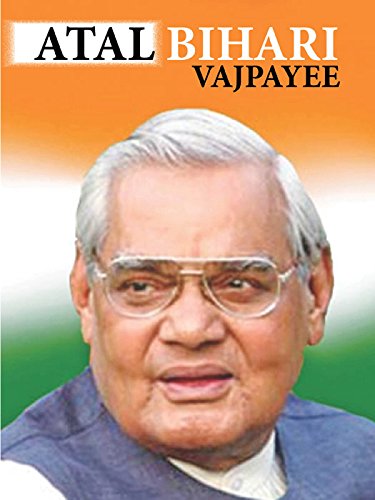
Atal Bihari Vajpayee was an Indian politician who served three terms as the Prime Minister of India: first for a term of 13 days in 1996, then for a period of 13 months from 1998 to 1999, and finally, for a full term from 1999 to 2004. A member of the Bharatiya Janata Party (BJP), he was the first Indian prime minister who was not a member of the Indian National Congress party to have served a full five-year term in office.He was a member of the Indian Parliament for over four decades, having been elected to the Lok Sabha, the lower house, ten times, and twice to the Rajya Sabha, the upper house. He served as the Member of Parliament for Lucknow,Uttar Pradesh until 2009 .
CHILDHOOD AND EDUCATION:
Vajpayee was born to Krishna Devi and Krishna Bihari Vajpayee on 25 December 1924 in Gwalior.Vajpayee did his schooling at the Saraswati Shishu Mandir in Gwalior. In 1934, Atal Bihari was admitted to AVM School Barnagar Distt Ujjain after his father joined as headmaster.He subsequently attended Gwalior's Victoria College for B.A. in Hindi, English and Sanskrit. He completed his post-graduation with an M.A. in Political Science from DAV College, Kanpur.His activism started with Arya Kumar Sabha of Gwalior, the youth wing of the Arya Samaj, of which he became the general secretary in 1944. He also joined the Rashtriya Swayamsevak Sangh (RSS) as volunteer, in 1939. Influenced by Babasaheb Apte, he attended the Officers Training Camp of the RSS during 1940–1944.He gave up studying law due to the partition riots. He quickly began working for the newspapers of Deendayal Upadhyaya, Rashtradharma, Panchjanya and the dailies Swadesh and Veer Arjun.
BJS PARTY:
By 1942, at the age of 16 years, Vajpayee became an active member of the Rashtriya Swayamsevak Sangh. In August 1942, he and his elder brother Prem were arrested for 24 days during the Quit India Movement.
In 1951, Vajpayee was seconded by the RSS, along with Deendayal Upadhyaya, to work for the newly formed Bharatiya Jana Sangh, a Hindu right-wing political party associated with the RSS. He was appointed as a national secretary of the party in charge of the Northern region, based in Delhi. He soon became a follower and aide of party leader Syama Prasad Mukherjee. In 1954, Vajpayee was with Mukherjee when the latter went on a hunger strike in Kashmir to protest the perceived inferior treatment of non-Kashmiri Indian visitors to the state.Mookerjee died in prison during this strike. In the 1957 Indian general election, Vajpayee contested elections to the Lok Sabha, the lower house of Indian parliament. He lost to Raja Mahendra Pratap in Mathura, but was elected from Balrampur.
After the death of Deendayal Upadhyaya, the leadership of the Jana Sangh passed to Vajpayee. He became the national president of the Jana Sangh in 1968, running the party along with Nanaji Deshmukh, Balraj Madhok, and L. K. Advani.
Vajpayee was among the founding members of the Bharatiya Jana Sangh (BJS), of which he was the president from 1968 to 1972. The BJS merged with several other parties to form the Janata Party, which won the 1977 general election.Vajpayee became the Minister of External Affairs in the cabinet of Prime Minister Morarji Desai. As foreign minister, Vajpayee became the first person in 1977 to deliver a speech to the United Nations General Assembly in Hindi.
Vajpayee resigned from his post in 1979.The Janata Party collapsed soon after Desai resigned as Prime Minister in 1979.The erstwhile members of the Bharatiya Jana Sangh came together to form the Bharatiya Janata Party (BJP) in 1980, with Vajpayee as its first President.
In 1986 L. K. Advani took office as president of the BJP.Under him, the BJP returned to a policy of hardline Hindu nationalism. It became the political voice of the Ram Janmabhoomi Mandir Movement, which sought to build a temple dedicated to the Hindu deity Rama in Ayodhya. The temple would be built at a site believed to be the birthplace of Rama after demolishing a 16th-century mosque, called the Babri Masjid, which then stood there. The strategy paid off for the BJP; it won 86 seats in the Lok Sabha in the 1989 general election, making its support crucial to the government of V. P. Singh.
AS PRIME MINISTER:
The BJP became the single largest party in parliament in the 1996 general election, helped by religious polarisation across the country as a result of the demolition of the Babri Masjid.Indian president Shankar Dayal Sharma invited Vajpayee to form the government.Vajpayee was sworn in as the 10th Prime Minister of India,but the BJP failed to muster a majority among members of the Lok Sabha. Vajpayee resigned after 13 days when it became clear that he did not have enough support to form a government.
After the fall of the two United Front governments between 1996 and 1998, the Lok Sabha was dissolved and fresh elections were held. The 1998 general elections again put the BJP ahead of others. A number of political parties joined the BJP to form the National Democratic Alliance (NDA), and Vajpayee was sworn in as the Prime Minister.The coalition was an uneasy one,as apart from the Shiv Sena, none of the other parties espoused the BJP's Hindu-nationalist ideology.Vajpayee has been credited for managing this coalition successfully, while facing ideological pressure from the hardline wing of the party and from the RSS. Vajpayee's government lasted 13 months until mid-1999 when the All India Anna Dravida Munnetra Kazhagam (AIADMK) under Jayalalithaa withdrew its support. The government lost the ensuing vote of confidence motion in the Lok Sabha by a single vote on 17 April 1999.As the opposition was unable to come up with the numbers to form the new government, the Lok Sabha was again dissolved and fresh elections were held.
NUCLEAR TESTS:
In May 1998, India conducted five underground nuclear tests in the Pokhran desert in Rajasthan, 24 years after its first nuclear test (Smiling Buddha) in 1974. Two weeks later, Pakistan responded with its own nuclear tests making it the newest nation with declared nuclear capability. In spite of intense international criticism and steady decline in foreign investment and trade, the nuclear tests were popular domestically. In effect, the international sanctions imposed failed to sway India from weaponising its nuclear capability. US sanctions against India and Pakistan were eventually lifted after just six months.
LAHORE SUMMIT:
In late 1998 and early 1999, Vajpayee began a push for a full-scale diplomatic peace process with Pakistan. With the historic inauguration of the Delhi-Lahore bus service in February 1999, Vajpayee initiated a new peace process aimed towards permanently resolving the Kashmir dispute and other conflicts with Pakistan. The resultant Lahore Declaration espoused a commitment to dialogue, expanded trade relations and mutual friendship and envisaged a goal of denuclearised South Asia. This eased the tension created by the 1998 nuclear tests, not only within the two nations but also in South Asia and the rest of the world.
KARGIL WAR:
In May 1999 some Kashmiri shepherds discovered the presence of militants and non-uniformed Pakistani soldiers in the Kashmir Valley, where they had taken control of border hilltops and unmanned border posts. The incursion was centred around the town of Kargil, but also included the Batalik and Akhnoor sectors and artillery exchanges at the Siachen Glacier.
The Indian army responded with Operation Vijay, which launched on 26 May 1999.Over 500 Indian soldiers were killed in the three-month-long Kargil War, and it is estimated around 600-4,000 Pakistani militants and soldiers died as well.India pushed back the Pakistani militants and Northern Light Infantry soldiers. Almost 70% of the territory was recaptured by India.
After Pakistan suffered heavy losses, and with both the United States and China refusing to condone the incursion or threaten India to stop its military operations, General Musharrafwas and Nawaz Sharif asked the remaining militants to stop and withdraw to positions along the LoC. The militants were not willing to accept orders from Sharif but the NLI soldiers withdrew. The militants were killed by the army or forced to withdraw in skirmishes which went beyond the announcement of withdrawal by Pakistan.
1999-2002:
In the 1999 general elections, the BJP-led NDA won 303 seats out of the 543 seats in the Lok Sabha, in the aftermath of the Kargil operations, thereby securing a comfortable and stable majority. On 13 October 1999, Vajpayee took oath as Prime Minister of India for the third time.A national crisis emerged in December 1999, when Indian Airlines flight IC 814 from Kathmandu to New Delhi was hijacked by five terrorists and flown to Afghanistan. The hijackers made several demands including the release of certain terrorists like Masood Azhar from prison. Under extreme pressure, the government ultimately caved in. Jaswant Singh, the Minister of External Affairs at the time, flew with the terrorists to Afghanistan and exchanged them for the passengers.
In March 2000, Bill Clinton, the President of the United States, paid a state visit to India.President Clinton's visit was hailed as a significant milestone in relations between the two nations. Vajpayee and Clinton had wide-ranging discussions on bilateral, regional and international developments.The visit led to expansion in trade and economic ties between India and the United States.
In March 2001, the Tehelka group released a sting operation video named Operation West End which showed BJP president Bangaru Laxman, senior army officers and NDA members accepting bribes from journalists posing as agents and businessmen. The Defence Minister George Fernandes was forced to resign following the Barak Missile scandal involving the botched supplies of coffins for the soldiers killed in Kargil, and the findings of an inquiry commission that the government could have prevented the Kargil invasion.
Vajpayee initiated talks with Pakistan, and invited Pakistani President Pervez Musharraf to Agra for a joint summit, the Agra summit. President Musharraf was believed in India to be the principal architect of the Kargil War.By accepting him as the President of Pakistan, Vajpayee chose to move forward. But after three days of much fanfare, which included Musharraf visiting his birthplace in Delhi, the summit failed to achieve a breakthrough as President Musharraf declined to leave aside the issue of Kashmir.
On 13 December 2001, a group of masked, armed men with fake IDs stormed the Parliament House in Delhi.The terrorists managed to kill several security guards, but the building was sealed off swiftly and security forces cornered and killed the men who were later proven to be Pakistan nationals.Vajpayee ordered Indian troops to mobilise for war, leading to an estimated 500,000[ to 750,000 Indian soldiers positioned along the international border between India and Pakistan. Pakistan responded by mobilising its own troops along the border.A terrorist attack on an army garrison in Kashmir in May 2002 further escalated the situation. As the threat of war between two nuclear capable countries, and the consequent possibility of a nuclear exchange, loomed large, international diplomatic mediation focused on defusing the situation. In October 2002, both India and Pakistan announced that they would withdraw their troops from the border.
The Vajpayee administration brought in the Prevention of Terrorism Act in 2002. The act was aimed at curbing terrorist threats by strengthening powers of government authorities to investigate and act against suspects. It was passed in a joint session of the parliament, amidst concerns that the law would be misused.
GUJARAT RIOTS:
In February 2002, a train filled with Hindu pilgrims returning to Gujarat from Ayodhya stopped in the town of Godhra. A scuffle broke out between Hindu activists and Muslim residents, and amidst uncertain circumstance, the train was set on fire leading to the deaths of 59 people. The charred bodies of the victims were displayed in public in the city of Ahmedabad, and the Vishwa Hindu Parishad called for a statewide strike in Gujarat. These decisions stoked anti-Muslim sentiments. Blaming Muslims for the deaths, rampaging Hindu mobs killed thousands of Muslim men and women, destroying Muslim homes and places of worship. The violence raged for more than two months, and more than 1,000 people died.
Gujarat was being ruled by a BJP government, with Narendra Modi as the chief minister. Vajpayee reportedly wanted to remove Modi, but was eventually prevailed upon by party members to not act against him.He traveled to Gujarat, visiting Godhra, and Ahmedabad, the site of the most violent riots. He announced financial aid for victims, and urged an end to the violence.While he condemned the violence,he did not chastise Modi directly in public. Vajpayee was accused of doing nothing to stop the violence, and later admitted mistakes in handling the events. K. R. Narayanan, then president of India, also blamed Vajpayee's government for failing to quell the violence.After the BJP's defeat in the 2004 general elections, Vajpayee admitted that not removing Modi had been a mistake.
2004 ELECTIONS:
In 2004 elections, BJP could only win 138 seats in the 543-seat parliament,with several prominent cabinet ministers being defeated. The NDA coalition won 185 seats. The Indian National Congress, led by Sonia Gandhi, emerged as the single largest party, wining 145 seats in the election. The Congress and its allies, comprising many smaller parties, formed the United Progressive Alliance, accounting for 220 seats in the parliament.Vajpayee resigned as Prime Minister.
DEATH:
On 11 June 2018, Vajpayee was admitted to AIIMS in critical condition following a kidney infection.He was officially declared dead there at 5:05 pm IST on 16 August 2018 at the age of 93.
HONOUR:
- In August 2018, Naya Raipur was renamed as Atal Nagar.
- In October 2018, four Himalayan peaks near Gangotri glacier named after his name.
- On 5 November 2018, the Uttar Pradesh government renamed the Ekana International Cricket Stadium in Lucknow to Bharat Ratan Atal Bihari Vajpayee International Cricket Stadium in his honour.
AWARDS:
- 1992, Padma Vibhushan
- 1993, D. Lit. from Kanpur University
- 1994, Lokmanya Tilak Award
- 1994, Outstanding Parliamentarian Award
- 1994, Bharat Ratna Pandit Govind Vallabh Pant Award
- 2015, Bharat Ratna
- 2015, Bangladesh Liberation War honour

No comments:
Post a Comment