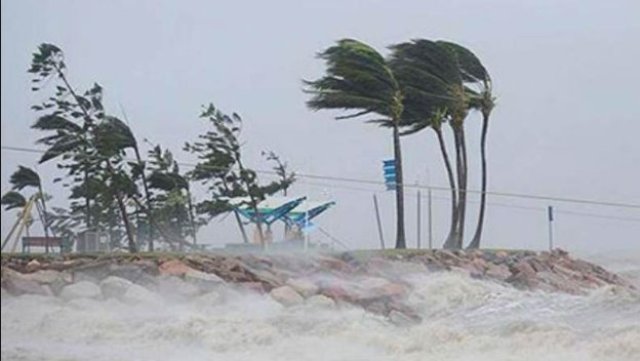
 CYCLONE FORMATION:
The cyclone that is caused in the tropical area near the equator are called as tropical cyclones.In places like India where it is peninsular , on the month of september to december there are lots of chances of cyclone formation as the Indian oceans are the warm water current ocean.It brings a lot of damage to both the eastern and western coastlines which runs for about 2000-3000 miles on both sides.
To form a cyclone, warm, moist air over the ocean rises upward from near the surface. As this air moves up and away from the ocean surface, it leaves is less air near the surface. So when the warm air rises, it causes an area of lower air pressure below. To form a cyclone, warm, moist air over the ocean rises upward from near the surface. As this air moves up and away from the ocean surface, it leaves is less air near the surface. So as the warm air rises, it causes an area of lower air pressure below. Air from surrounding areas with higher air pressure pushes in to the low pressure area. Then this new air formed again becomes warm and moist and rises and as the cycle continues it forms clouds.This process is repeated more times and thus the clouds thus formed grow and increase its size and the resulted storm which is formed rotates faster and faster, an eye forms in the centre. It is very calm and clear in the eye, with very low air pressure. Higher pressure air from above flows down into the eye.
When the winds in the rotating storm reach 63 kmph, the storm is called a tropical storm and when the wind speeds reach 119 kmph, the storm is officially a tropical cyclone”. Tropical cyclones usually weaken when they hit land, because they are no longer being fed by the energy from the warm ocean waters. However, they often move far inland, dumping many centimeters of rain and causing lots of wind damage before they die out completely.
CYCLONE CHART:
CATEGORY 1: Less than 125 km/h. Minimal house damage.
CATEGORY 2: 125 - 164 km/h. Destructive winds and moderate storm.
CATEGORY 3: Severe Tropical Cyclone. 165 - 224 km/h. Very destructive winds above moderate and extensive storm
CATEGORY 4:Severe Tropical Cyclone. 225 - 279 km/h. Very destructive winds and extreme storm.
CATEGORY 5: Severe Tropical Cyclone. More than 280 km/h. Extremely destructive winds and castastrophic storms.

No comments:
Post a Comment